Protein Standard for Busy Men: Hit 180g Eating Out Every Day
Apr 2, 2026
by Mike Barbato
Protein Standard for Busy Men: Hit 180g Eating Out Every Day

If you eat at restaurants three or four nights a week and you've been trying to track your macros with an app, here's what's happening: the app works fine on Monday. By Thursday at a client dinner in a good restaurant, nobody's scanning barcodes or estimating portion sizes on their phone. The app closes. The week goes sideways. You start over Monday.
There's a simpler system. It doesn't require an app. It doesn't require meal prep. It requires one decision made before you open the menu.
The Protein Anchor Rule for Men Who Eat Out
The rule is this: decide your protein anchor before you look at the menu. Every meal, every restaurant, every city. Before the bread basket, before the specials, before anyone suggests splitting the appetizer, you've already decided: steak, salmon, chicken, or shrimp.
That's the decision. One protein main, made in advance. Everything else builds around it.
Here's why this matters more than tracking: the point in a restaurant meal where nutrition falls apart is almost always the decision point, not the actual food. When you sit down hungry and open a menu with twenty options after a twelve-hour day, you pick what sounds good, not what hits your protein target. The anchor rule eliminates that decision. You already made it.
The Numbers: What a Protein Anchor Actually Gets You
Here's the simple math so you can stop guessing:
- 6-ounce filet mignon: approximately 42g protein
- 8-ounce salmon fillet: approximately 45g protein
- Double chicken breast: approximately 55-60g protein
- 6-ounce shrimp (about 15 large): approximately 35g protein
Three meals built around a protein anchor and you're at 130-180g for the day. Add Greek yogurt or cottage cheese at breakfast and you're at the top end without doing anything complicated.
The protein standard for men over 40 trying to maintain or build muscle while losing body fat is approximately 0.8-1g per pound of bodyweight. For a 185-pound guy, that's 150-185g per day. The anchor rule gets you there consistently without a single logged entry.
The Full 3-Step Restaurant System
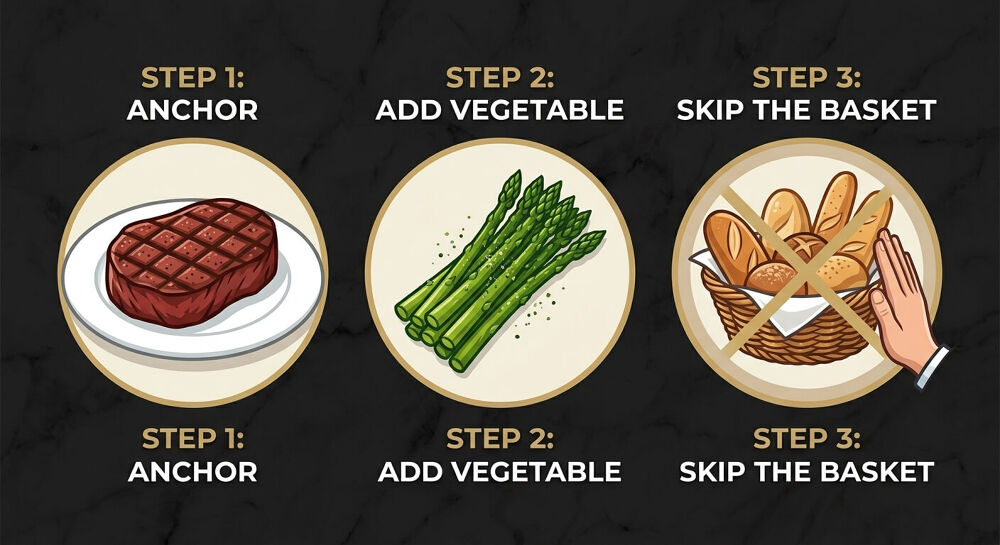
Once you have the anchor rule in place, two more moves complete the system:
Step 1: Order your protein anchor first. Steak, salmon, chicken, or shrimp. Decided before you open the menu. Non-negotiable.
Step 2: Add one vegetable side. Doesn't matter which one. Something green. Asparagus, broccoli, spinach, Brussels sprouts. Just pick one and order it without thinking about it further.
Step 3: Skip the bread basket. Not because bread is the enemy. Because it's 300-400 extra calories that you didn't decide on, you just ate because it was there. That one move alone changes the trajectory of the meal. Push it to the other side of the table or ask the server not to bring it.
Anchor. Vegetable. Skip the basket. Three decisions, made in advance, applied at every meal. That's the whole system.
The Pass/Fail Test for Your Current Approach
Does your current approach to nutrition work when you're eating out four nights in a row on a travel week?
If the answer is no, or if the answer is "it depends on how disciplined I'm being," then the approach isn't built for your actual life. It's built for a version of your life where you have time to prep food, eat at home most nights, and avoid social and business situations that involve restaurants.
That life doesn't exist for most executives. The system has to work at the Marriott in Dallas just as well as it works at your kitchen in Malvern. The anchor rule does that. Tracking apps mostly don't.
Kettlebell training Malvern PA and online is built around the same principle: simple rules that hold up when the week doesn't cooperate. Three sessions a week, forty minutes, with a nutrition framework you can apply anywhere.
If you want the full system, training and nutrition, built specifically around your schedule, local guys can start with the 6-Week Metabolic Reset on April 13: precisionkettlebells.com/metabolic-reset.
For the online program that travels with you, Kettlebell KUTS is the 16-week version: precisionkettlebells.com/kettlebell-kuts.